



A historic preservation project nearly two years in the making is nearing completion at Stephenson Park in Lowell, Iowa, along the banks of the Skunk River. The effort centers on preserving a nearly 200-year-old millstone that has now been carefully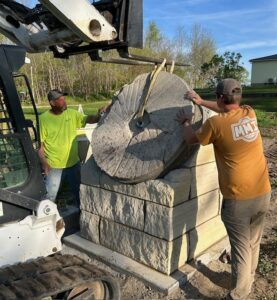 moved to higher ground and reset into a cut-stone monument base.
The work was highlighted during an event held yesterday morning, April 23rd, at Stephenson Park.
The restoration project is led by the Mount Pleasant James Harlan Chapter of the Daughters of the American Revolution, or DAR. The early 19th-century French Buhr millstone was originally used in a mill in pioneer Lowell during the 1830s. In 1930, the stone was placed on a monument along the Skunk River by the James Harlan DAR chapter and the John See DAR Chapter of New London. Over time, years of severe weather, flooding, and even a fallen tree damaged the original monument.
Through grants and coordinated funding, the DAR oversaw construction of a new monument using Anamosa limestone. Henry County Conservation Officer Caleb Waters, the Conservation Department, and others assisted by preparing the large base required to support the heavy stone. Funding for the project has been provided by the William M. and Donna J. Hoaglin Foundation, Incorporated, Enhance Henry County Community Foundation, Henry County Historic Preservation Commission, and the National Society of the Daughters of the American Revolution.
Design work, stonecutting, and the careful movement of the millstone were completed by McClure Masonry of Burlington. Jason McClure and his employees moved the stone to their Burlington shop last fall, where it was preserved and banded through the winter while stone blocks were cut to size for assembly this spring. The millstone has since been lifted into a specially cut groove in the monument, and the original brass plaque describing the mill’s history will be mounted to the stone.
Millstones like this one originated in France and were made largely from a type of quartz known as buhrstone. Constructed from smaller pieces cemented together and banded with iron, they were valued for their sharp and durable grinding surfaces used in producing white flour.
The James Harlan DAR Chapter is preparing a broader history of the mills at Lowell and plans to host a public re-dedication ceremony for the monument at a later date. Historians at the Dover Museum in New London will be consulted as part of the historical presentation.
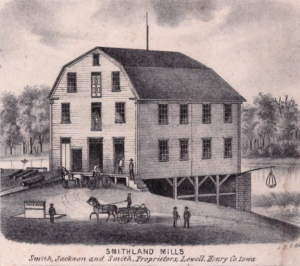
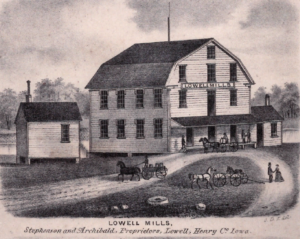
The Lowell site marks the location of Henry County’s first mills. Settlement in the area followed the defeat of Chief Black Hawk in 1832 and the Black Hawk Purchase in 1833. By 1835, settlers were drawn to the fertile land and opportunities along the Skunk River, known to Native Americans as the Chicaqua.
In 1837, early settlers Hiram Smith and James Caudill built one of the first mills along the river to grind grain and saw wood, laying the foundation for the growth of the village that would eventually be named Lowell.
A special thank you to Cathy and David Helman for the information and photos included in this article.